

Frigya

How Frigya works

In Frigya a word makes two stops: you meet it in Discover, then reinforce it in Learn with spaced repetition. This page walks through both stages, then a realistic daily routine.

Stage 1

Discover: the introduction stage

  1. 1 A word from your chosen language and level appears.
  2. 2 You pick the correct meaning from four options, either on its own or inside a sentence.
  3. 3 If you get it right on the first try, the word counts as already known and needs no extra review.
  4. 4 If you do not know it, you see the meaning and an example sentence and move on.
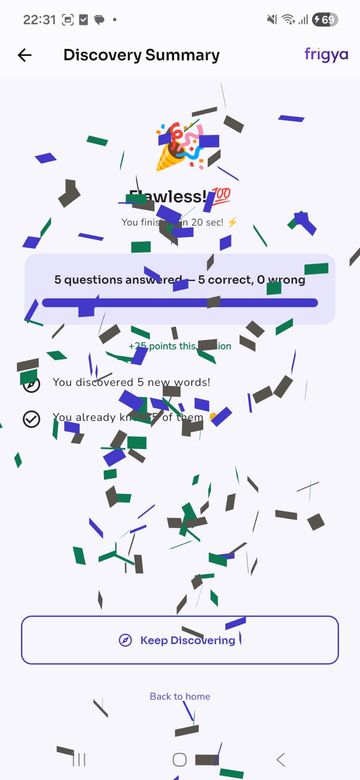
  5. 5 When you finish your daily goal, a summary shows how many words you discovered, how many you already knew and how many points you earned.
Stage 2

Learn: the consolidation stage

  1. 1 Learn unlocks once you have discovered your first few words.
  2. 2 The words you discovered are asked again using spaced repetition: you see them again as you get close to forgetting them.
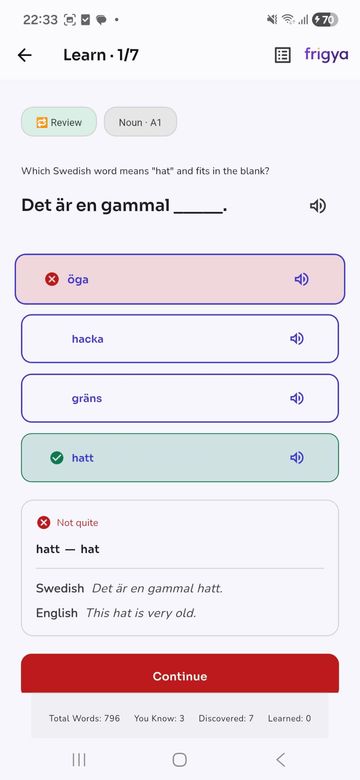
  3. 3 After each answer you see the correct meaning and an example sentence; a mistake is part of learning too.
  4. 4 You continue until the review pool is finished or you stop. You can review as much as you like.

Why two stages?

Meeting a word for the first time and remembering it months later are different jobs. The first needs curiosity and attention; the second needs good timing. Mix them on one screen and you either see only new words and forget old ones, or only repeat and feel you are not moving forward.

That is why Frigya separates them. Discover is bounded by your daily goal; Learn keeps track of the words you left behind. Keeping the daily goal modest also keeps the review load manageable.

Frigya Discover summary: 5 questions, 5 correct, points earned and how many words you already knew
Frigya Learn question: choosing the Swedish word that fits the blank in a sentence

The idea behind spaced repetition

In the 1880s, the German psychologist Hermann Ebbinghaus showed that what we learn fades quickly unless reviewed, and that forgetting is fast at first and slower later. It is known as the forgetting curve.

Later research supports two things: spreading reviews over time (the spacing effect) and trying to recall information (retrieval practice) improve long-term retention. Spaced repetition systems combine both. For more, read What is spaced repetition? A plain-English guide for language learners.

Exact numbers vary by person, word and context, so we do not promise results like "this many days to this much retention".

A realistic daily routine

An example day with a goal of 10 words. Timings vary from person to person; this is a suggestion, not a measurement taken from Frigya.

  1. Morning

    Discover: 10 new words. Ones you already know are marked as known automatically.

  2. Lunch break

    Learn: finish your pending reviews. Turn on question audio to hear the pronunciation.

  3. Evening

    Check your goal history and streak. On a long day, one short Learn session is enough.

Your first session: four steps

  1. 1

    Pick your language

    Check one or more languages you want to learn.

  2. 2

    Set your level and goal

    For each language, choose levels from A1–C2 and a daily word goal.

  3. 3

    Start Discover

    Meet your first group of words and see your result on the summary screen.

  4. 4

    Unlock Learn

    After a few discovered words Learn opens; continue with reviews.

Do your first session today

Try it without an account. If you like it, link your progress to one.

Get it on Google Play iOS: Coming soon The App Store version is in preparation